Retail-Powered Mobile Banking
Meeting Walmart shoppers where their money lives
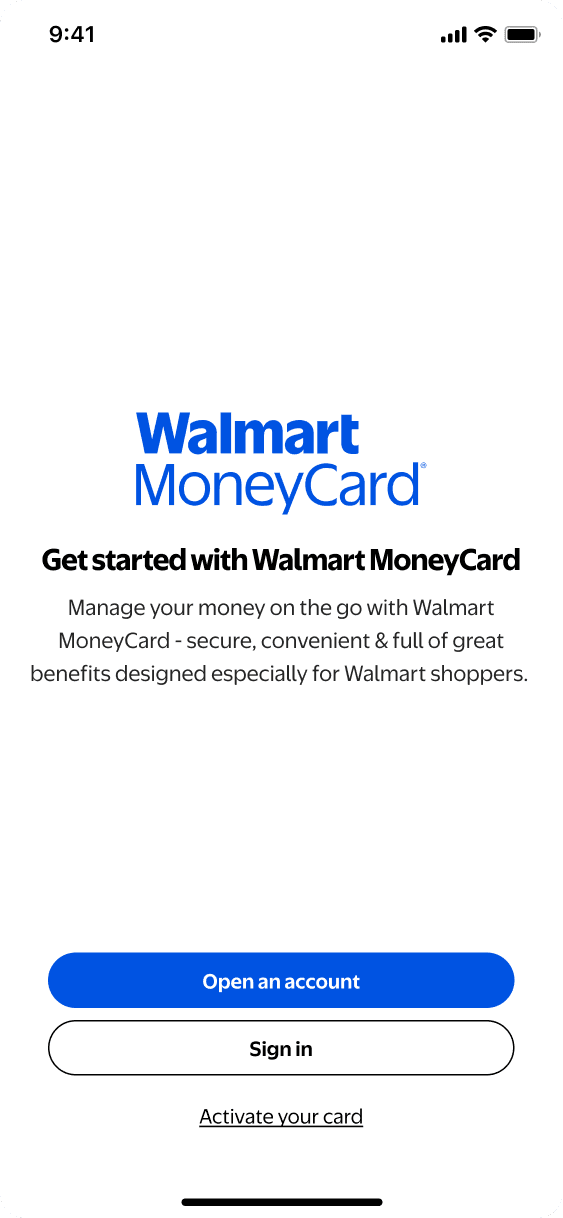
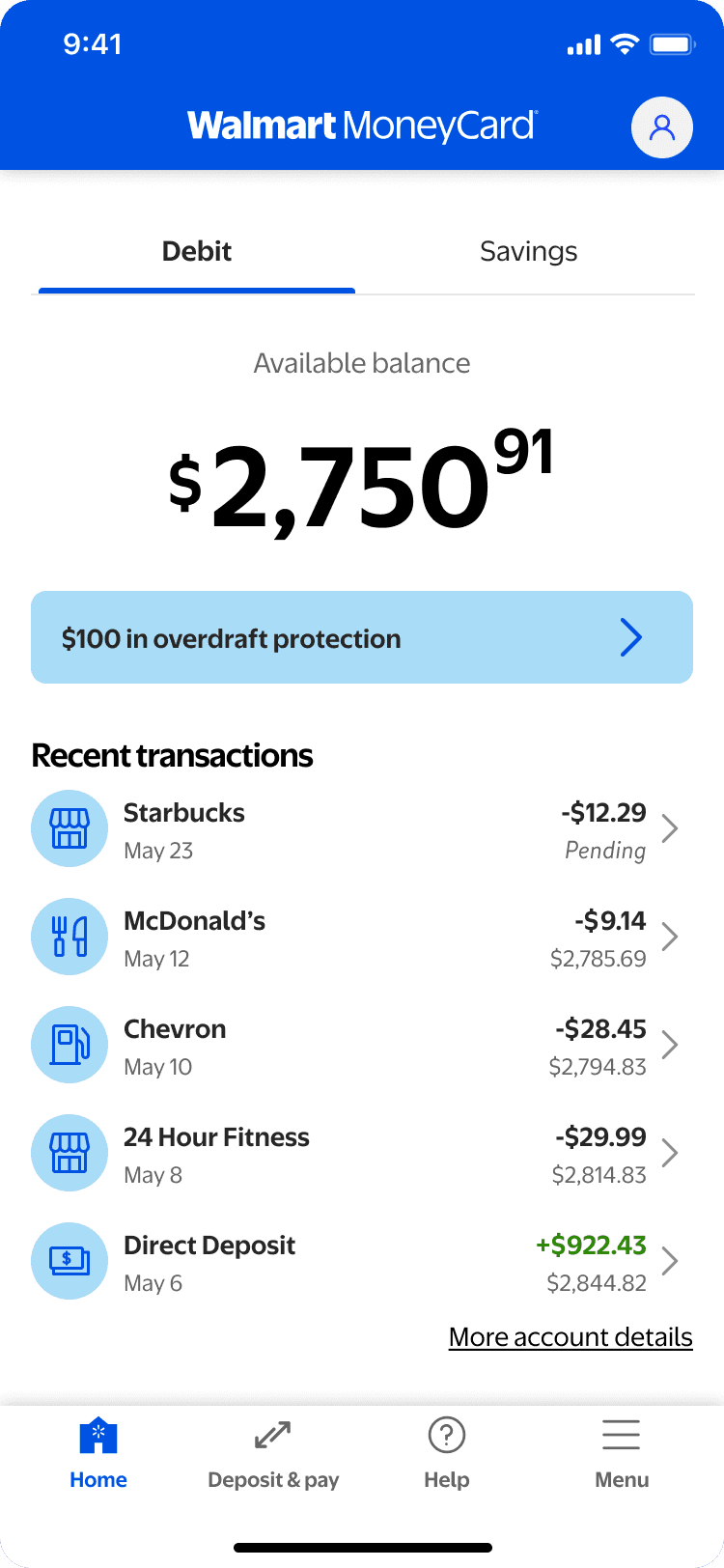
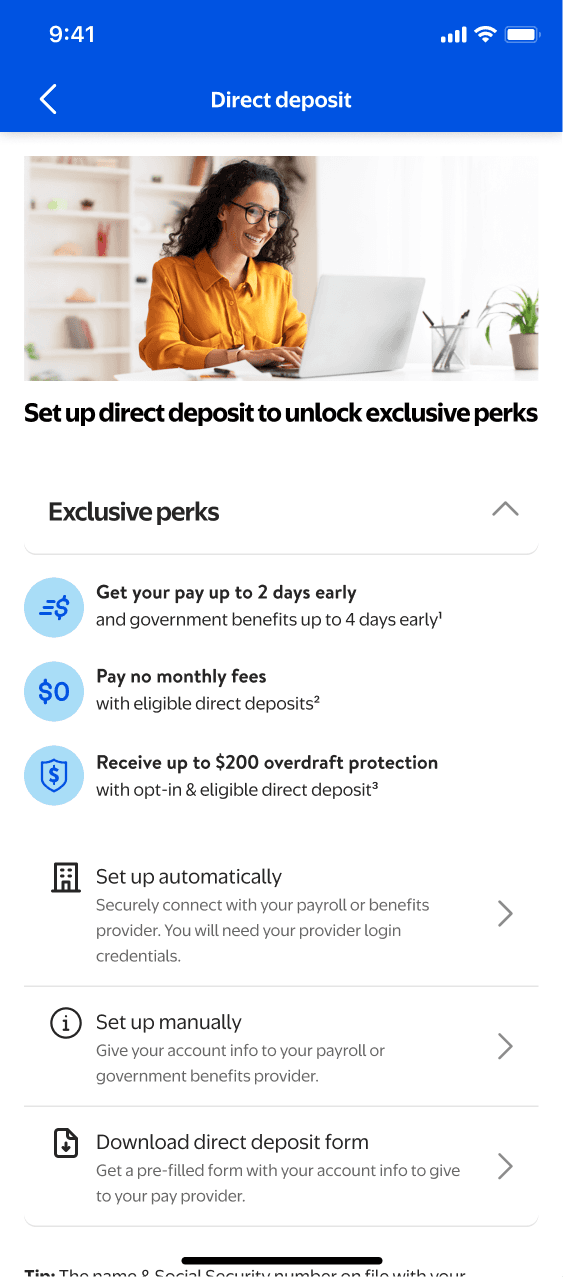
Walmart’s mobile banking app, originally launched in 2015 (program launched in 2006), offers core financial features such as overdraft protection and savings tools for Walmart shoppers. Walmart MoneyCard provides over a million active users across the US easy access to their money while they shop at Walmart.
Timeline
10 months from design to delivery
Background/Context
The Walmart MoneyCard (WMMC) mobile banking app, first launched in 2015, had remained largely unchanged for years. While it continued to perform reliably, the product’s aging infrastructure limited opportunities for innovation and feature growth. During our internal UX Refresh (UXR) initiative, we shared several blue-sky concepts that reimagined what the MoneyCard experience could be. Walmart was inspired by the vision and decided to prioritize a full redesign of the app. Our team was given roughly one year to transform the product—from a stable but dated banking tool into a modern, user-focused experience.
Problem
Despite its success, the existing WMMC app had not evolved to meet the changing expectations of modern banking users. The legacy backend system restricted design flexibility, making it difficult to introduce new features or improve user flows. The challenge was to redesign the experience within technical constraints—while ensuring the product still felt fresh, intuitive, and aligned with Walmart’s brand values of accessibility and trust.
Role/Contribution
As the lead designer for this partnership initiative, I collaborated closely with product managers, engineers, and stakeholders from both Walmart and Green Dot Bank. I led design workshops, contributed to the UX and product strategy, and created end-to-end design solutions—from research and wireframes to high-fidelity prototypes. My focus was on simplifying complex financial interactions and ensuring the new experience was scalable, inclusive, and easy for everyday shoppers to use. One of the key focus was to retain existing users.
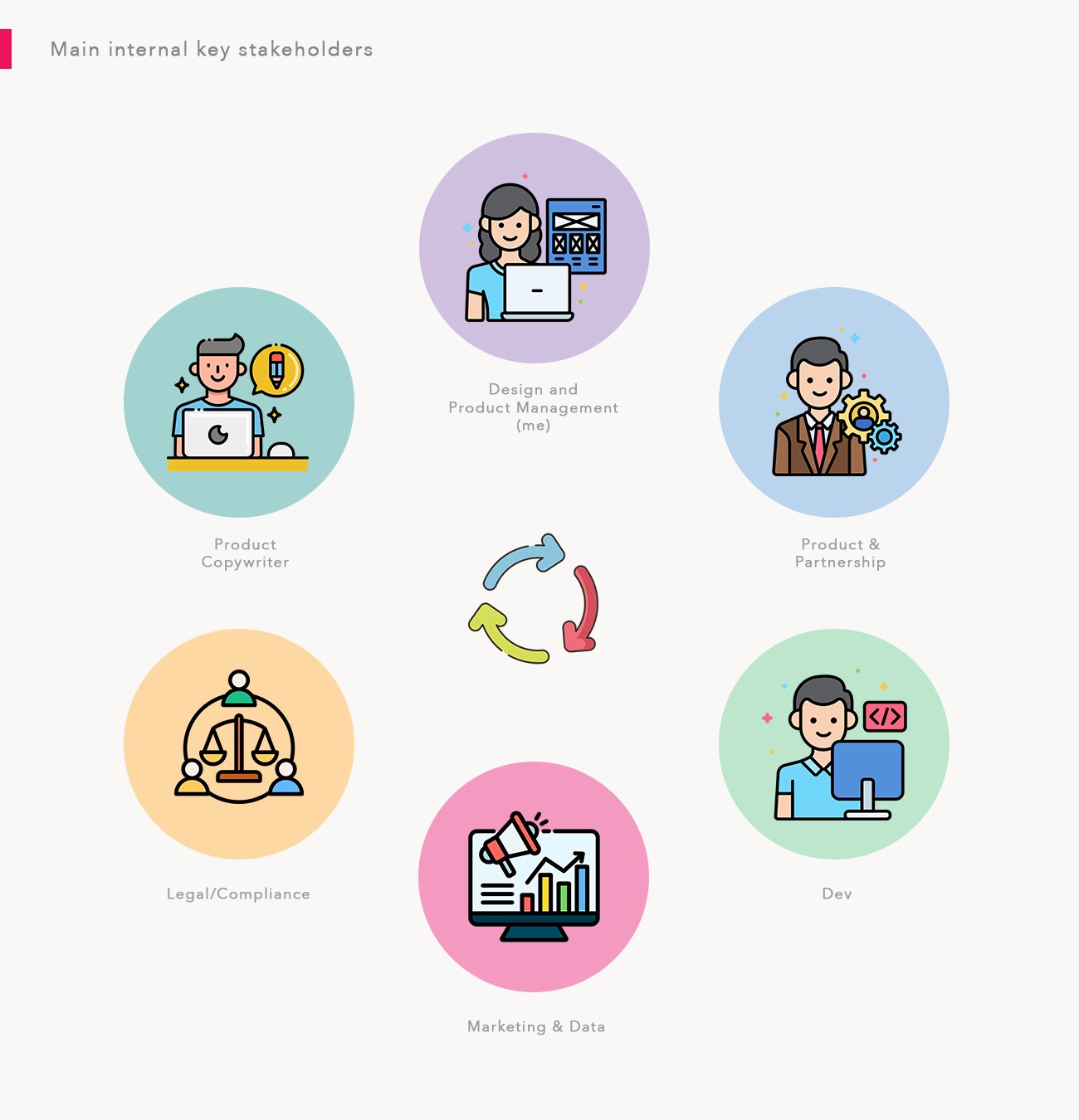
I had an overall step-by-step approach taken during the 10 month long process, including research, planning, design, development, testing, and optimization.*
Discovery & Planning Research
To understand the current experience and uncover opportunities for improvement, our team began with a comprehensive audit of the existing WMMC app. We reviewed user feedback, app store reviews, and support tickets to identify recurring pain points and usability issues.
Through our findings, we discovered that while users valued the app’s reliability, ease of use, and transparency. Users often struggled with outdated UX, lack of personalization, and limited visibility into their financial health as Walmart shoppers. Many users viewed the app as a functional necessity rather than a helpful financial companion.*
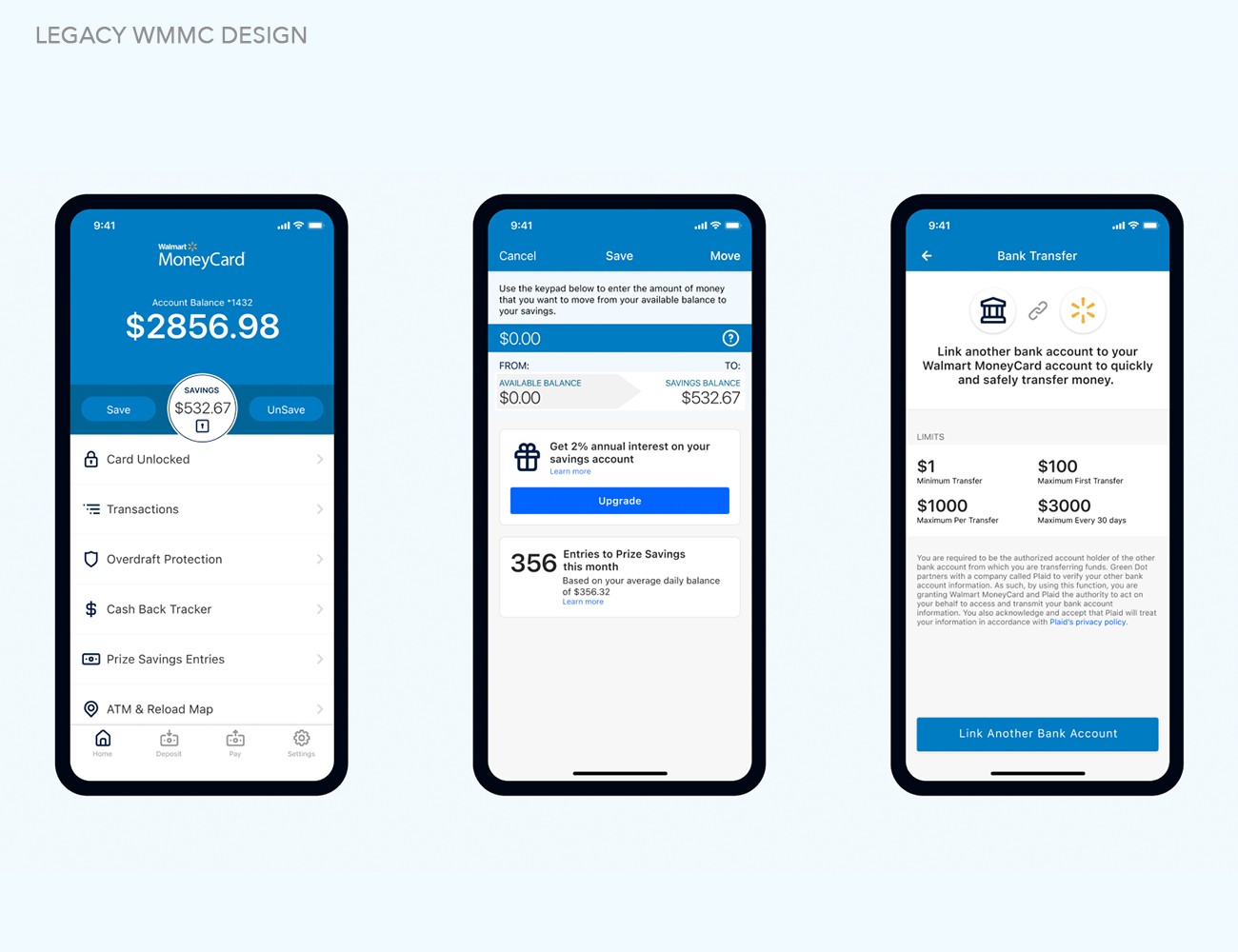
To validate these insights, we conducted stakeholder interviews and competitive benchmarking against leading financial institutions and retail-fintech products. We were also able to work with data and analytics to pull information on users' habits and use cases. These sessions helped us define our design priorities:
Rethink the user experience for improved user engagement and navigation
Modernize the visual language for better accessibility and consistency
Empower users with features that encourage financial confidence and control
Design Strategy
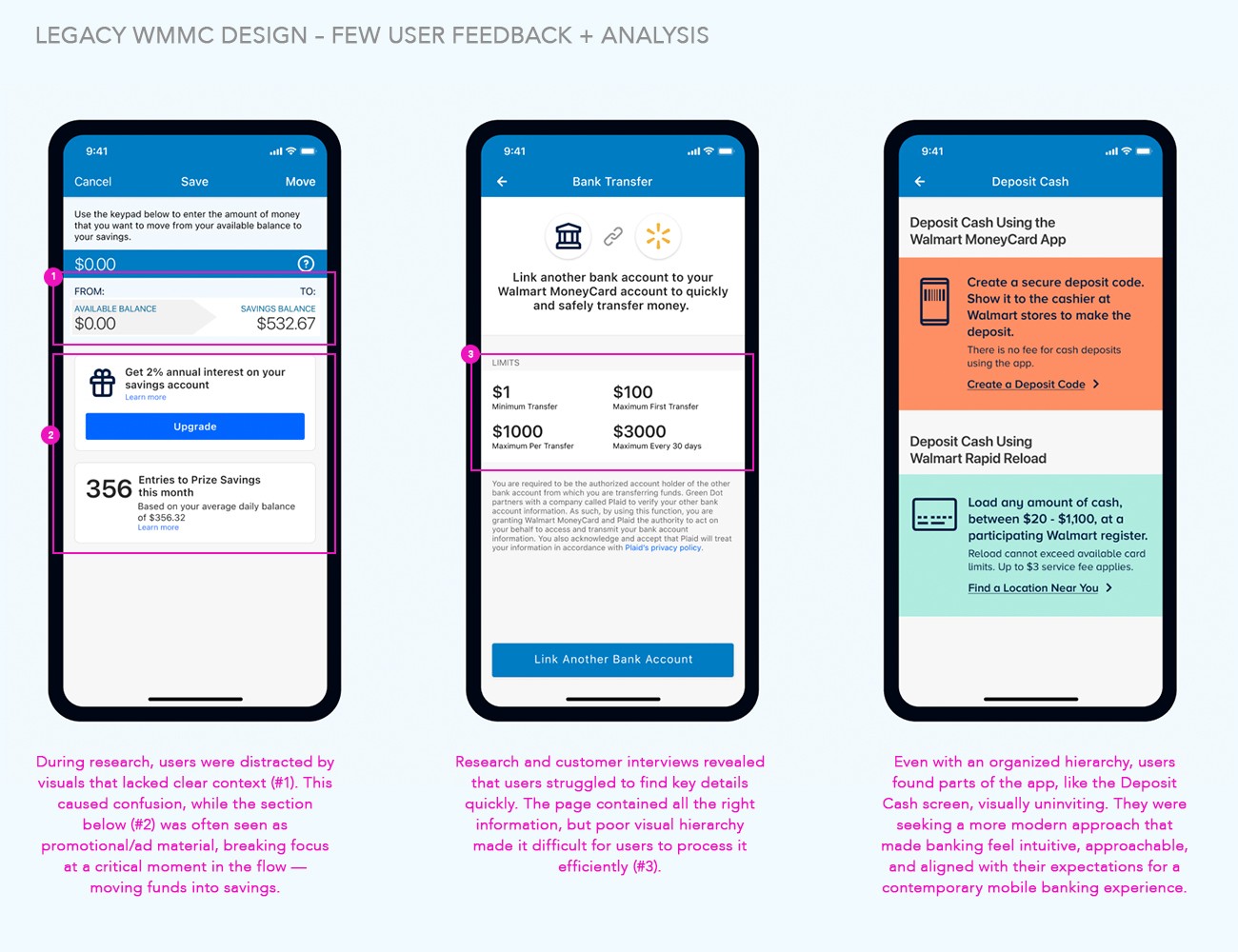
Our design strategy focused on creating a modern, human-centered banking experience that felt simple, transparent, and empowering. To achieve this, we aligned our goals around three guiding principles:
Clarity and simplicity > complexity – streamline the interface to reduce cognitive load and make key actions (like checking balances or managing savings) easily accessible
Consistency across various touchpoints – refresh the visual design system to match Walmart’s brand evolution while maintaining alignment with Green Dot Bank’s functionality
Scalability for future innovation – establish a design foundation and updated design systems that could support future features without major structural overhauls, and across other Green Dot partnership products (white label)
I worked closely with engineering and product stakeholders to ensure each design decision balanced business goals, user needs, and technical feasibility throughout the exploration and iteration process. I was able to lead ideation process with requirement and product planning sessions with product and engineers. Regular design reviews and collaborative workshops helped us align on priorities and maintain momentum throughout the year-long timeline. I also ran several blind usability testing to help us make the right call in various points of the product. The design systems designer joined to help build an efficient and WCAG compliant design systems.*
Ideations & Explorations
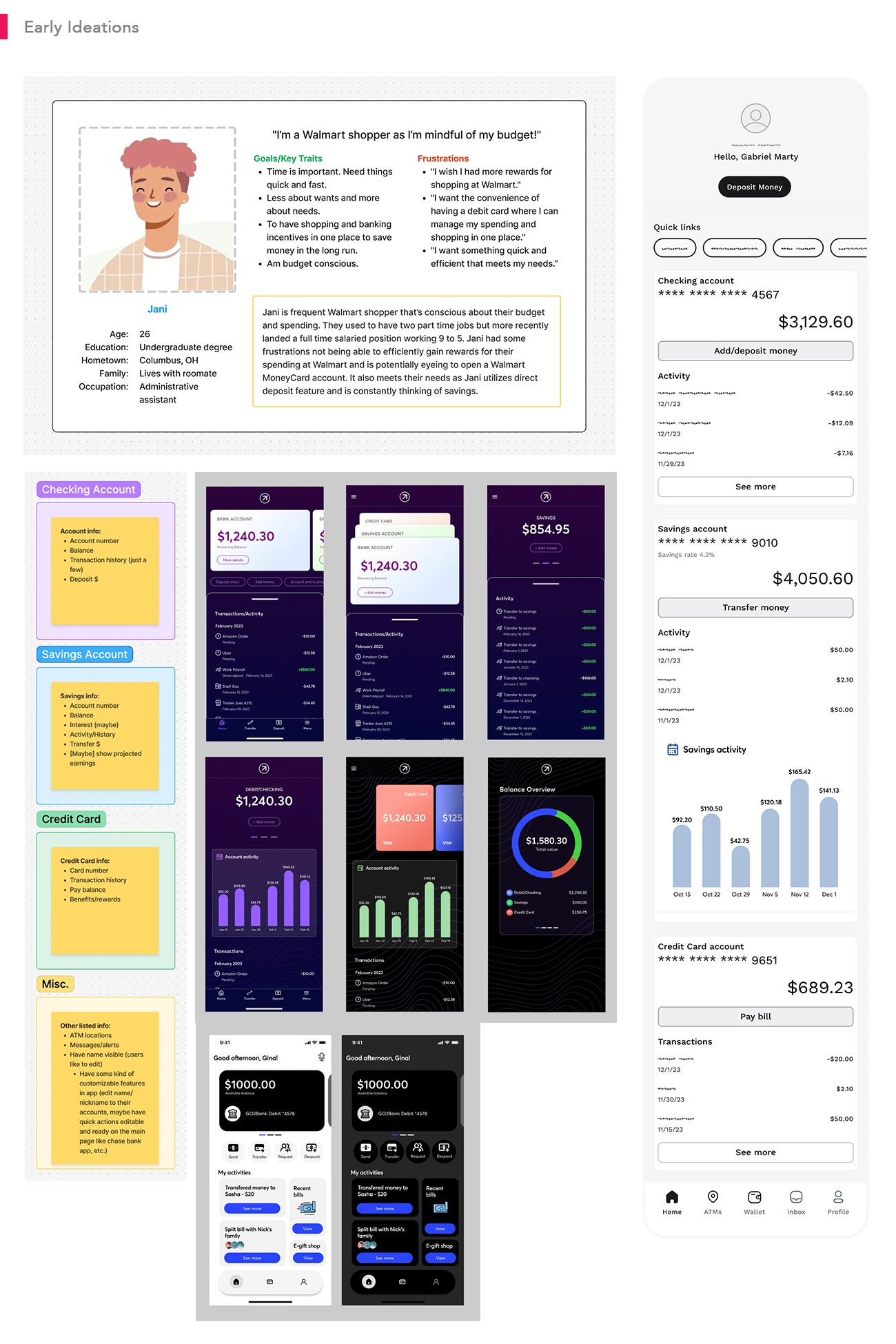
Early explorations focused on:
Simplified dashboards that surfaced key financial insights at a glance and overall app UX
Streamlined navigation that reduced redundant pathways and remove various "promos"
Visual hierarchy and accessibility improvements to support a broader range of users
A more modern take on digital mobile banking
We created multiple low-fidelity prototypes to test these ideas quickly (among many others and for feature–based validation), gathering feedback from internal teams and select users to refine our direction before moving into high-fidelity design.
Design & Prototyping
With our concepts validated at multiple points in the design process, we transitioned to finalizing a cohesive, modern, and accessible mobile banking experience. We built on Walmart’s existing design language while introducing new components to the white-label system, ensuring the WMMC interface met contemporary UX and accessibility standards. The updated system emphasized clarity, contrast, and consistency, making everyday banking tasks intuitive and confidence-inspiring for users.
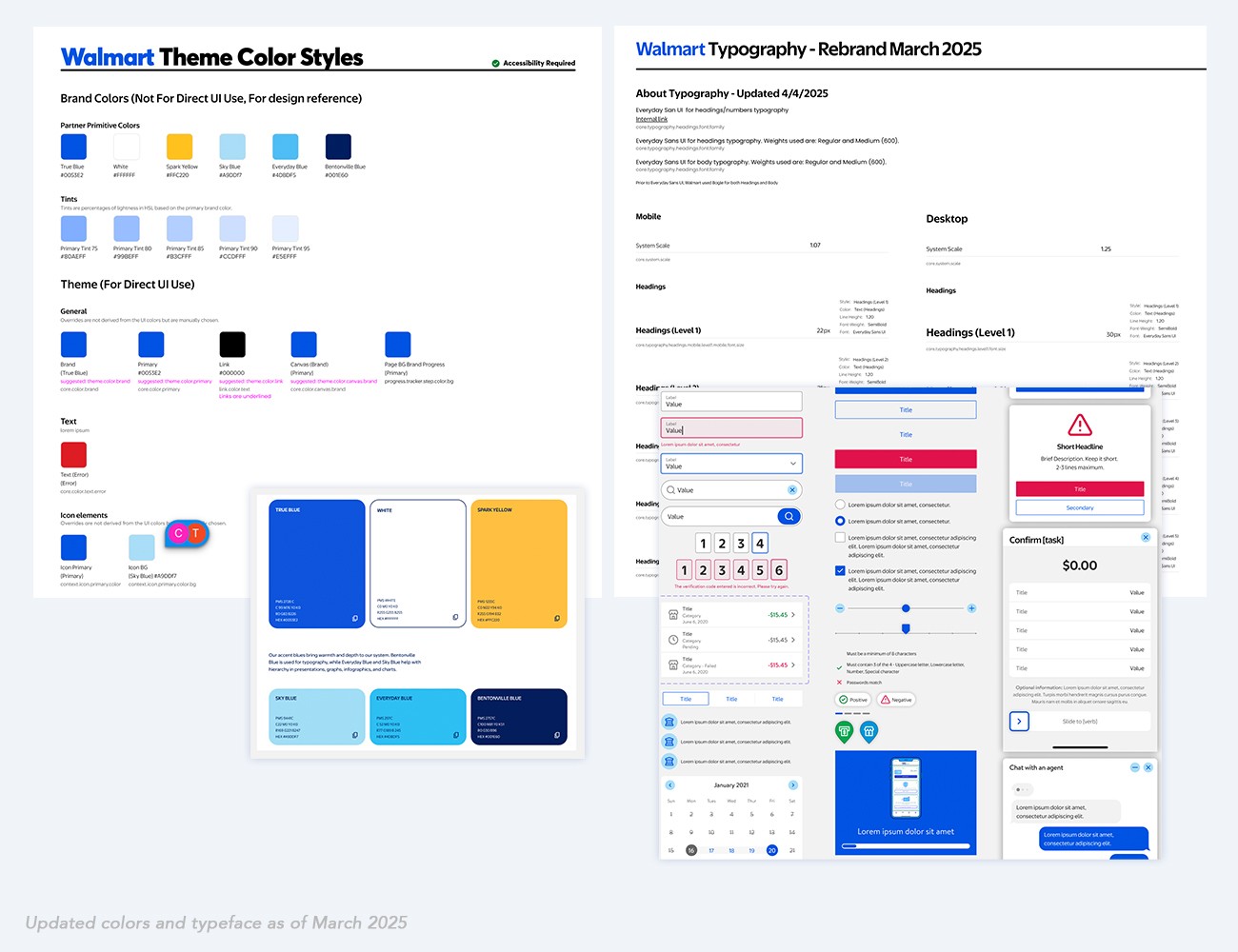
During this phase, we encountered a surprise: Walmart was updating their brand guidelines, including typefaces, colors, and icons. Although we were in the final stages of polishing the product, all stakeholders had to pause to review and update every completed and in-progress section of the app. This process added 2–3 weeks to our timeline, requiring an additional round of QA to ensure alignment with the new guidelines.
Key design improvements included:
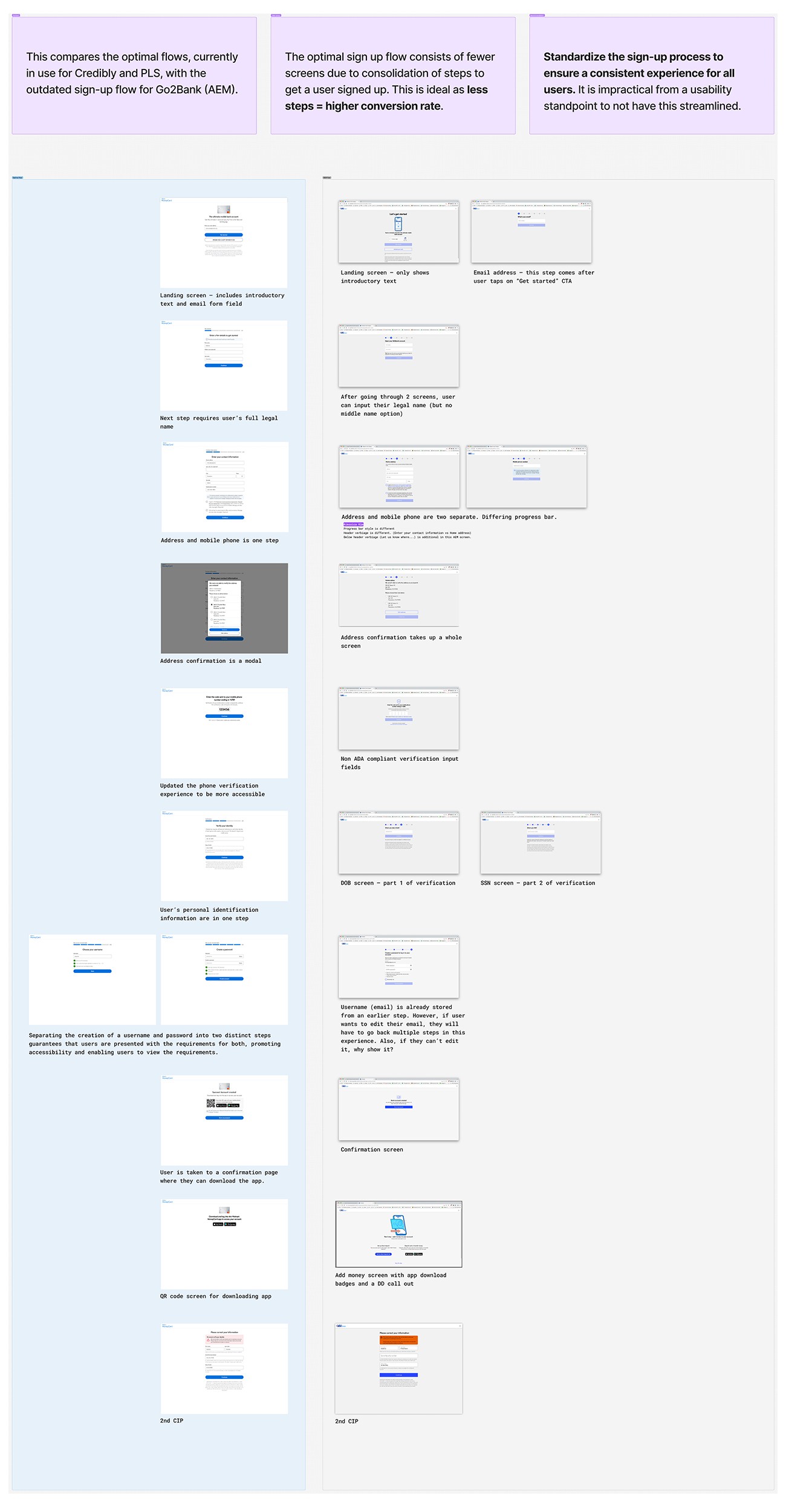
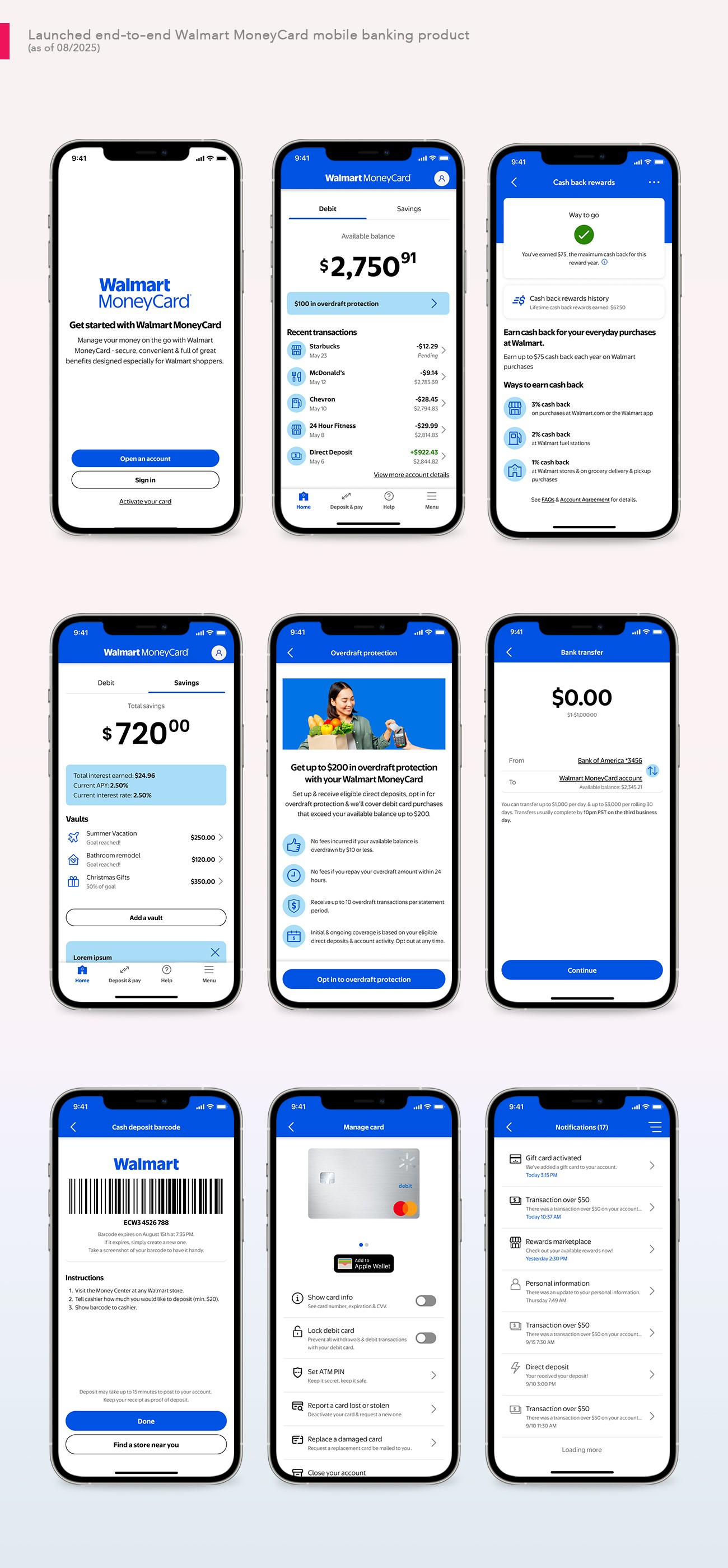
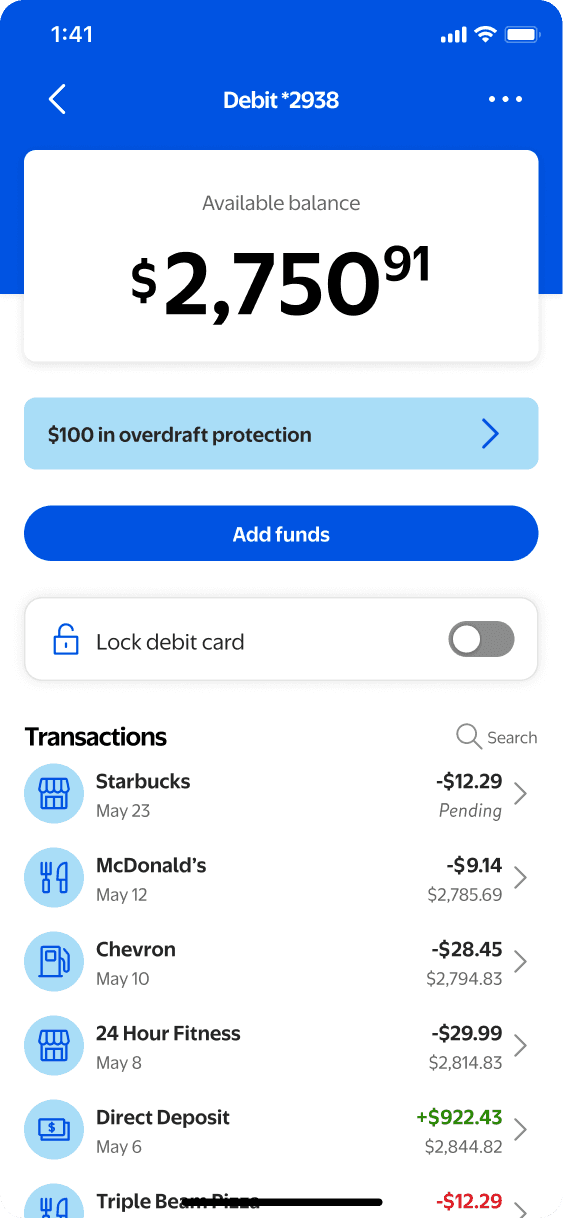
A refreshed home dashboard with clear visual hierarchy, clearly showing account balances, transaction history, and other key actions
Streamlined navigation using a simplified bottom tab structure for easier discovery and quicker access to core features
Enhanced visual language that balanced Walmart’s approachable brand personality with a clean, fintech-inspired aesthetic
Accessibility-first design choices, such as high color contrast, scalable typography, and iconography with strong visual meaning
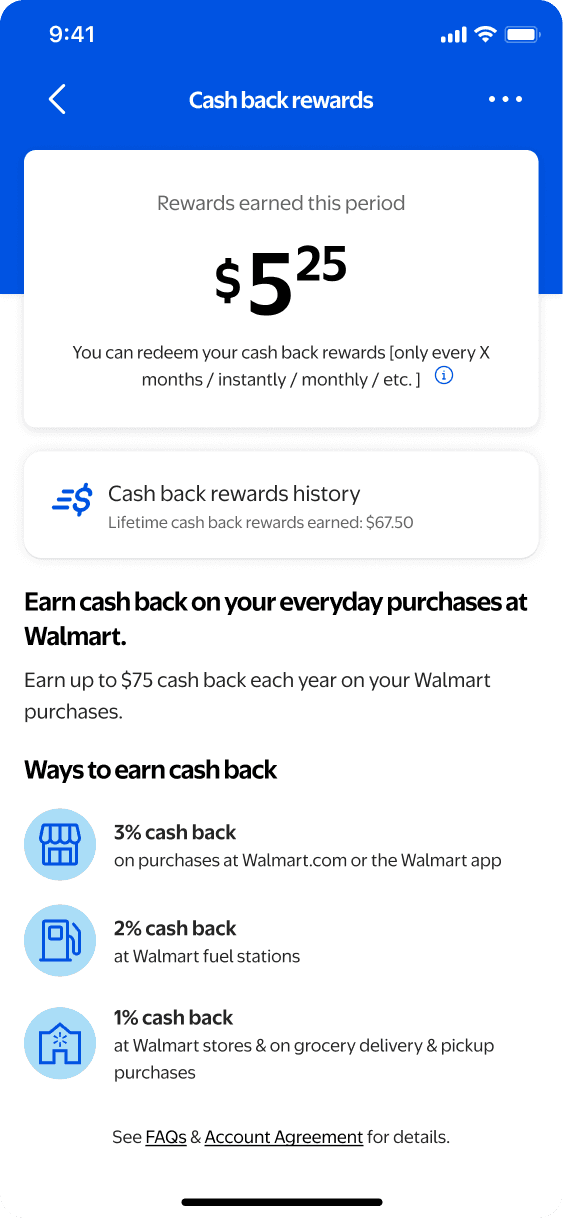
Feature enhancements to engage users and to increase opt-in rates
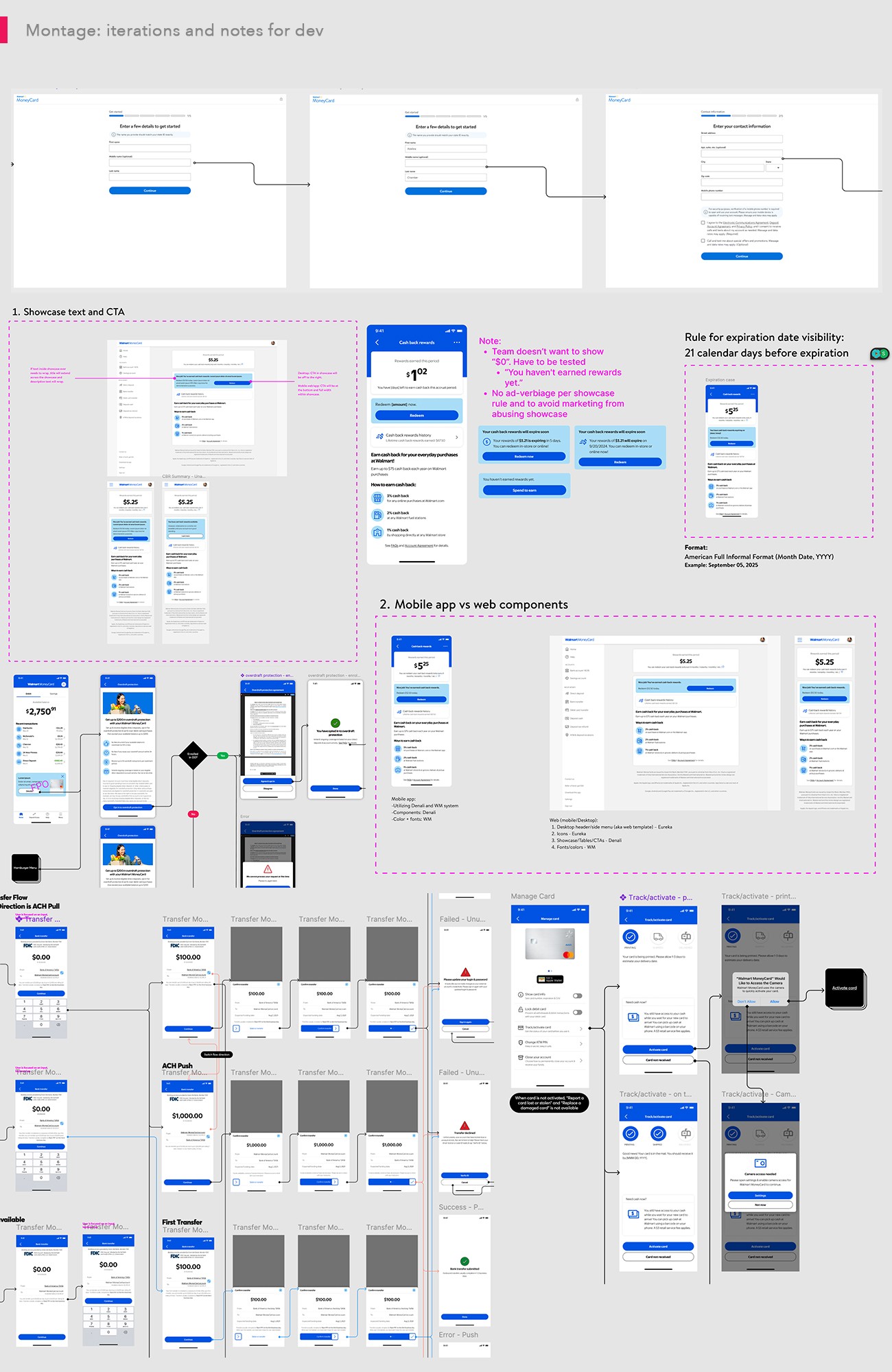
Throughout the process, I collaborated closely with product managers and engineers to ensure pixel-perfect implementation and seamless handoff through detailed design specs, annotated prototypes, and design QA sessions. Our highly collaborative and iterative process allowed us to maintain alignment across teams while incorporating feedback from user testing and stakeholder reviews with Walmart, ensuring the final experience met both business and user goals.
Development & Implementation
Leveraged agile development methodologies to build the newly designed and rebranded WMMC mobile banking app. We prioritized feature development based on existing user feedback, client feedback, existing data, and technical feasibility based on product scope/roadmap. We also had substantial efforts on QA with our internal QA team.
Testing & Optimization
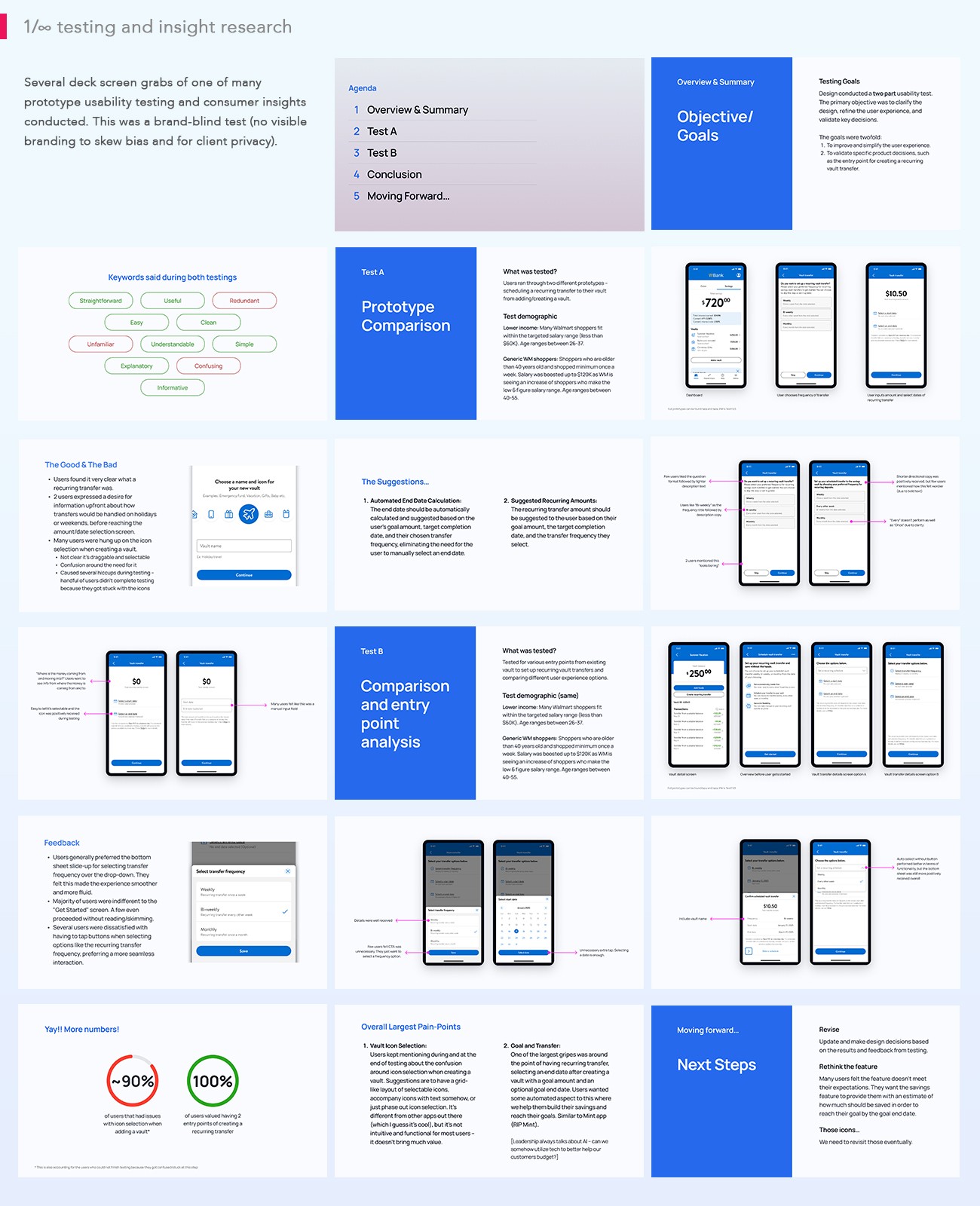
Throughout the process, we had several rounds of testing at various points of the design process. I conducted various rigorous blind testing to ensure usability, performance, and overall compatibility with users of various backgrounds. After gathering all sets of research data, the team and I were able to make further improvements to better optimize the product based on usability metrics.
Results & Impact
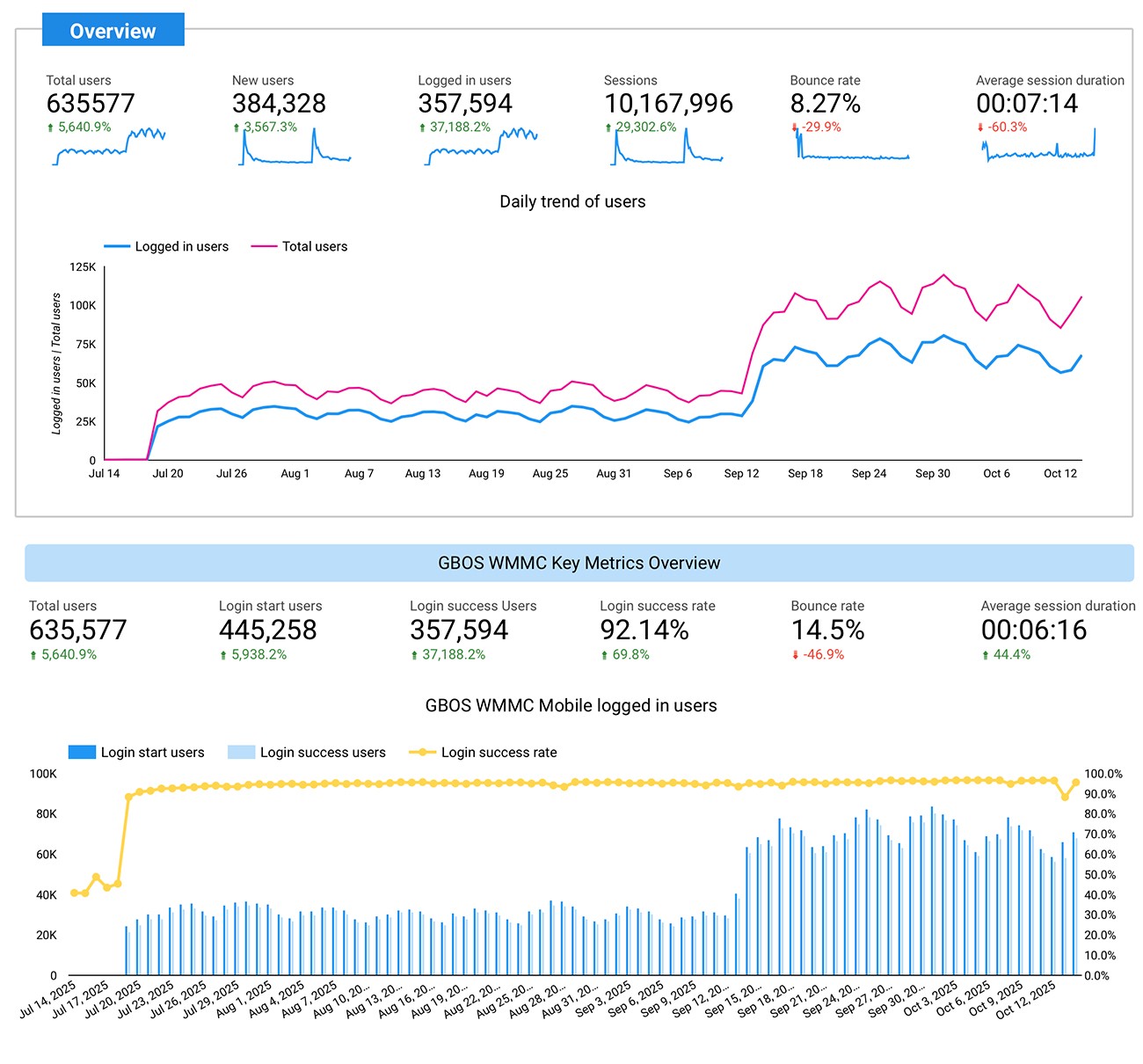
The redesigned Walmart MoneyCard (WMMC) app successfully launched within the one-year timeline, marking a major milestone in Walmart’s digital banking evolution. The refreshed experience modernized the app’s look and feel while addressing key usability issues that had built up over nearly a decade. The following were the results and impact from launch…
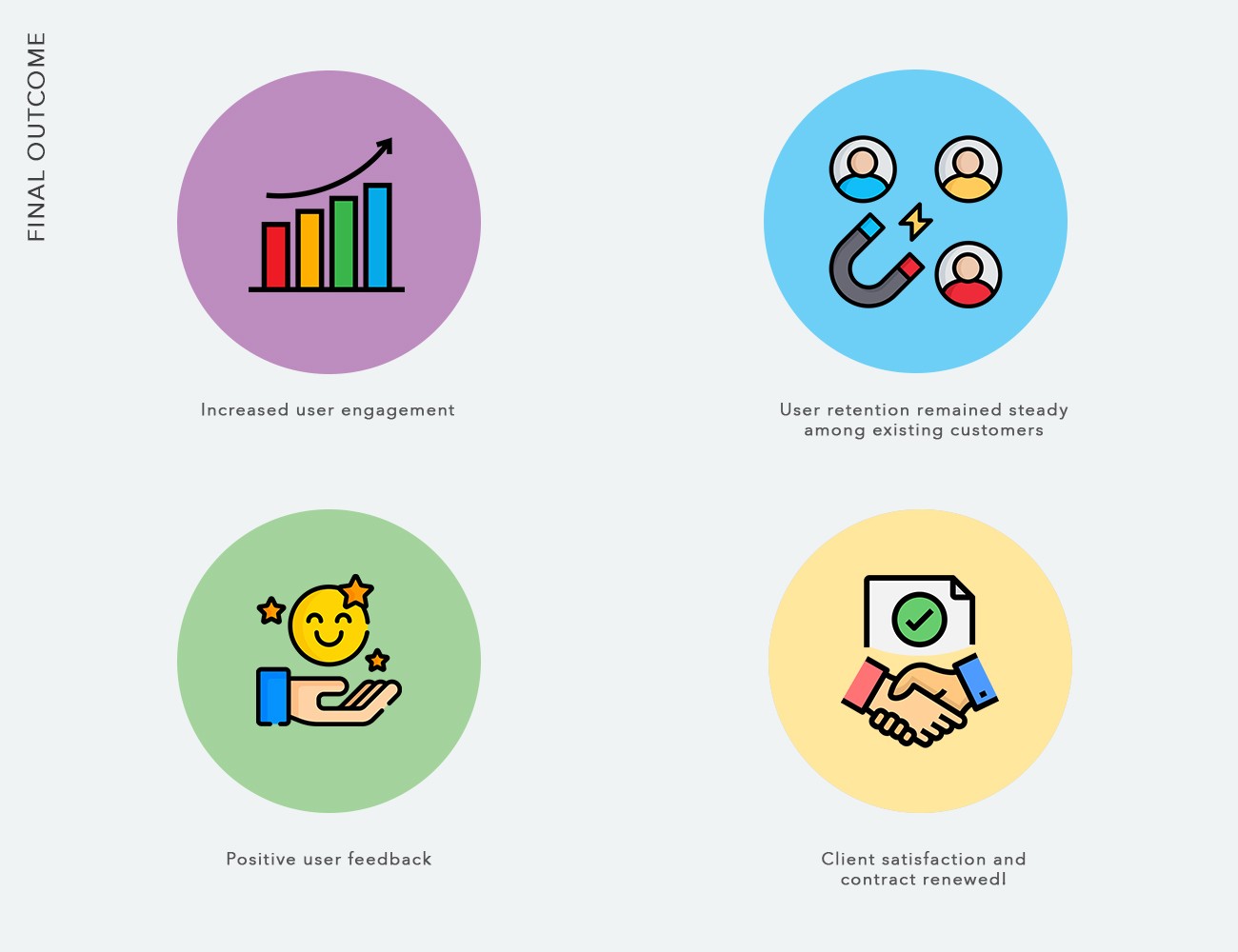
Increased Engagement
Increased user engagement and session frequency within the first three months
Positive User Feedback
Positive user and client feedback about the revamped design and overall UX refresh
Growth & Retention
Existing customer retention is steady; there is an uptick in new users and new card activations
Happy Client
Strong client satisfaction and successful delivery led to a renewed partnership contract with Walmart
What We Learned
This project reinforced the importance of collaboration, adaptability, and systems thinking in large-scale redesigns. Working within technical constraints required creative problem-solving and proactive communication with various stakeholders and partners to ensure feasibility without compromising the user experience. We also discovered users still value clean and innovative experiences, regardless if it's a "boring" industry or not. Users are always looking for engagement and products that excite them to use them as long as they are not overly complicated and achieves its purpose with functionality.